Every month we spend a day copying tables
From the store, from the ad accounts, from analytics, from accounting. Then by hand into one spreadsheet.
Services / data
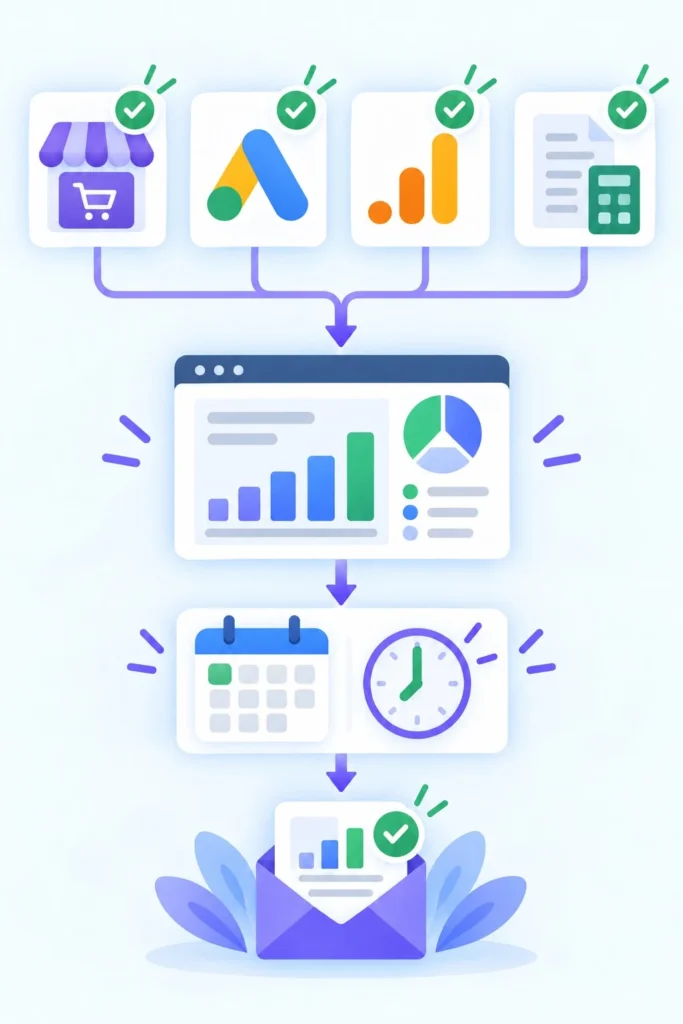
Sales from the store, spend from the ad accounts, traffic from analytics and the position from accounting, in one report that arrives when you need it, for example every Monday at 7am. Nobody copies a table.






























What we hear about reports
A report a person assembles costs a day every month and comes out slightly different every month.
From the store, from the ad accounts, from analytics, from accounting. Then by hand into one spreadsheet.
Sales in the store are not the same as sales in accounting. Nobody knows which figure is the real one.
By the time it is finished the month is over and the decision has already been made without it.
Whoever builds it builds it their own way. Comparing one month to another does not hold.
If one of those sounds familiar, we deal with it on the intro call: fifteen minutes, no obligation.
Send an enquiry →How a report that arrives on its own is built
What goes into the report
The data is pulled straight from the sources: WooCommerce, Google Ads, Meta, Google Analytics 4 and the accounting system. The report assembles itself and either arrives by email or stays permanently fresh at one link. The same columns every week, so comparisons hold. If the measurement is not set up correctly we fix that first, because a report built on wrong data is worse than no report.
From a spreadsheet to a report that arrives on its own
We look at which numbers are in it, where each one comes from, and how long the whole thing takes.
Every number gets a written source and a written calculation. This is the point where it becomes clear why sales and accounting never matched.
The report assembles itself and runs alongside the manual one for a month, so you can see whether it agrees.
You get the report at the same hour, an alert when something is out of line, and a note on how to add a column yourself.
If you build the report once a quarter and it takes an hour, automation is not worth it. We say so before the proposal.
Send an enquiry →What a report does not fix
If the measurement in the store or the ad accounts is wrong, an automated report will simply show the wrong numbers faster. At one client the ads reported zero conversions on 318 clicks because tracking was never set up. So we check the measurement first.
A report also does not decide anything. It says what happened. What to do about it is still your judgment, and a report is only worth having if somebody reads it every week.
For measurement that counts the right things, see analytics and conversion tracking. The report is the last step, not the first.
What is usually in the report
What sets the price
Measurement and analytics are billed at 35 EUR per hour. How many hours a report takes is decided by the points below.
The form below asks about exactly these things. The more you tell us, the more precise the proposal will be. Indicative prices for every service are on the price list.
Send an enquiry →The exact figure for your case arrives within a day of the call, itemized and with no hidden costs.
Send an enquiry →Why Aithena
A report is only as good as the data it is built from.
At one client the ads reported zero conversions on 318 clicks because tracking was never set up. A report built on that data would have looked good and been wrong.
So sales and accounting either agree, or you know exactly why they do not. That is the difference between a report and a spreadsheet.
At one client, process automation removed roughly 90 hours of manual work per month. With reports the saving is usually a day a month, and we measure it before the project starts.
Access to the sources and to the report is in your name, with a written note on how to add a column yourself. We do not sell a black box.
On the intro call we look at the report you build today and say which numbers would arrive on their own and which source has to be fixed first.
Send an enquiry →What you receive
Data from the store, the ad accounts and analytics is collected into one report at the agreed hour.
Immediately
We settle which numbers actually drive decisions and when you need them.
During the work
We connect the data and explain why the tools disagree with each other.
At handover
Instead of a day spent assembling tables, the report lands in your inbox in the same format every time.
Fit
We would rather tell you openly when a service is not right for you than have you spend money on something that will not work.
Good fit
Wrong timing
Questions
Answers to the questions we hear most often before an engagement starts.
Question not on the list?
WooCommerce, Google Ads, Meta, Google Analytics 4, Google Search Console, accounting systems with an API or an export, and spreadsheets. On the intro call we check yours.
Either, and often both: a dashboard for daily use and an email on Mondays. Email is simpler; a dashboard is always current.
Because they measure different things: orders against issued invoices, with or without VAT, with or without returns. We write down the source and the calculation for each number, and the difference either disappears or is explained.
A first report from two or three sources takes a few weeks, then a month running alongside the manual one for comparison.
Measurement and analytics are billed at 35 EUR per hour, or by a proposal that comes out of the inventory. Indicative prices are on the price list.
You get an alert when a number drops out or goes out of line. Fixing the source is usually a short job.
Reports work at the level of numbers, not individuals. Where a source contains personal data, it does not appear in the report. Access is in your name.
Book a call
The intro call takes about fifteen minutes. We look at your situation and say what is worth doing first.
You receive an itemized proposal the same or by the next business day at the latest after the call, not a week later with different numbers. If we judge that the service is not worth it for you, we say so before the proposal.
Prefer to call? +386 70 743 718, WhatsApp or info@aithena.co
Certified
 GoogleAI Essentials
 GoogleAnalytics
 IBMData Science
 n8nAutomation