











Services / ecommerce

Store optimization for more completed checkouts

A store with traffic and few orders rarely needs a new store. What it needs first is a measurement of where buyers give up, and then a fix for exactly that.

We work on stores we did not build
Measurement before the first fix
Fixes in order of impact
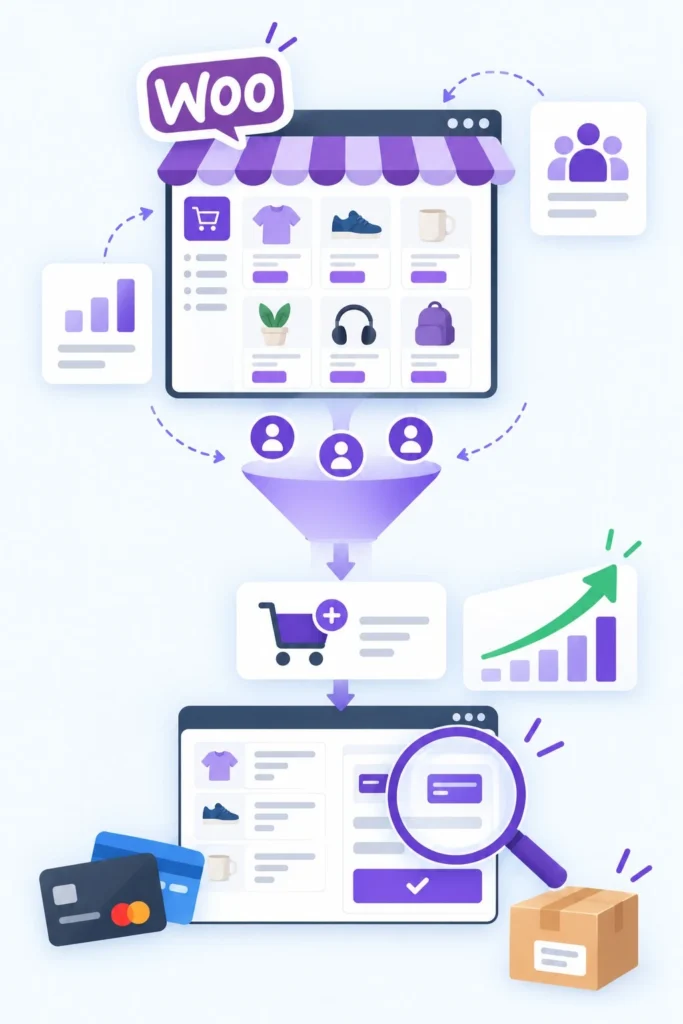
Store optimization: from the visit to the purchase
3languages in the largest store we run
4WooCommerce stores up and running
548products in the largest one we run
11 yearsof work on the web

Trusted by companies across the US, the EU and the UAE

See the work →

From the report · honesty before a nice number

Ghost.si: 18.24 EUR of sales per euro spent, and what we did not count

  1. Starting point

    A bike store. Buyers were reaching the order stage, and some stalled at financing through installment payments.

  2. What we did

    Meta ads to a landing page, and tracking from view to cart to order. In the report, kept apart: completed sales and purchase intent.

  3. Result

    May 2026: 257.79 EUR spent and five completed orders worth 4,702.67 EUR. June: 1,866 views, 28 add-to-carts and 10 orders worth 36,584.92 EUR, recorded as intent because the installment payments were never confirmed.

€18.24in sales per euro spent, May 2026
1,866landing page views, June
28add-to-carts
10orders as purchase intent, not as sales

The next step was checking how orders were being completed, not raising the budget. Read the full case study →

The store has traffic and no orders

Four sentences we hear almost every week

A store with traffic and few orders rarely needs a new store. It needs a measurement of where buyers give up.

01

We have traffic and no orders

People arrive, look and leave. How many drop out and where, nobody knows.

02

They abandon the cart just before paying

They reach the last step and then vanish. We cannot tell whether it is the shipping cost or something else.

03

It is slow on a phone

Most traffic comes from phones, where the product page takes too long to load. A buyer does not wait.

04

They cannot find the product

The catalog is large and the search and filters do not help. The buyer gives up at the third click.

If one of those sounds familiar, we deal with it on the intro call: fifteen minutes, no obligation.

Send an enquiry →

What we fix in a store

  • The product pagewhat is missing before a buyer clicks
  • The cartshipping costs that come as a surprise
  • Checkoutsteps that do not need to exist
  • Speedevery second costs you buyers
  • On-site searchthe buyer cannot find what you have in stock
  • Measurementwithout it every fix is guesswork

Where we look for the loss

Store optimization starts at where the sale stalls

Store optimization is not a redesign. It is a sequence of fixes along the path from arrival to payment, where every fix comes from data rather than opinion. We work on WooCommerce and on custom builds, including stores Aithena did not build.

Load speed and Core Web Vitals
Categories, filters and catalog search
Product pages that answer the objection
A cart and checkout without friction
Buying on a phone, start to finish
SEO for categories and product pages
Ecommerce tracking, so the effect is visible
Send an enquiry →

Where the sales drain away

Four places where purchases are most often lost

A slow store

The buyer leaves before the product page loads. On a phone and a weaker connection the difference is largest.

A catalog with no path through it

Anyone who cannot find the product in three steps will not try a fourth. The category names and the filters decide more than the home page does.

Friction at payment

Forced registration, an unclear shipping cost and too few payment methods stop the sale at the last step.

Blind measurement

Without correct ecommerce tracking nobody knows which step loses the buyers, so the fixing is done on instinct.

What optimization cannot do

What optimization cannot do

The industry sells this as a guaranteed percentage. We name the limits too, because otherwise you find them yourself, after paying.

From the measurement to more orders

Four steps from the measurement to more orders placed

  1. 1

    Measurement

    We build or verify the ecommerce tracking. Without it every fix is guesswork nobody can evaluate.

  2. 2

    Where the journey breaks

    We look at how many visitors reach the cart, how many reach checkout and how many finish. That immediately shows which step loses the most.

  3. 3

    Fixes in order of impact

    We work in order of impact, not in order of what is easiest. Every change is recorded, so it is clear what caused the difference.

  4. 4

    Before and after

    We compare the state before the change with the state after. If a fix did not work, we say so and remove it.

The first review of the store is part of the intro call and costs you nothing.

Send an enquiry →

The basics

What store optimization is

Store optimization is a sequence of fixes along the path from arrival to payment. It is not a redesign and it is not a new store.

Every fix comes from data rather than opinion, which is why the first step is always measurement. If the store does not record which step people drop out at, every conversation after that is guesswork.

The fixes are taken in order of impact, not in order of what is easiest: speed, categories and filters, product pages, the cart and the checkout. For each one you see how many orders it produced.

It works once you already have traffic. If you do not, what comes first is SEO and advertising, otherwise optimization has nothing to improve.

Where a purchase most often stalls

  1. Visitsomeone lands on a product
  2. The cartadded, not yet bought
  3. Checkouta form too long or unclear
  4. Paymentthe method they use is missing
  5. Purchasethe order is placed

Why Aithena

Five reasons, and the first is that we run stores ourselves

Store optimization is not advice on paper. It is changes to the catalog, the cart and the checkout.

01

We do not just advise on stores, we run them.

Simak Keramika has 548 products across 31 categories and three languages; Maveron Fashion more than 300 products; Tartuf.com 85 in two languages; Gigablock 66 categories in three languages. All four are WooCommerce and all four are running. The advice we give has been tested on stores we run ourselves.

02

We fix the measurement first and the catalog second.

Without correctly configured events nobody knows where the buyer gives up. At one client the advertising showed zero conversions on 318 clicks because the tracking had never been set up. That is the first thing to fix, not the last.

03

One change at a time, with the number written down before and after.

Every change has a baseline figure and a date on record. After two months it is clear exactly what moved the sales and what did not. It is also the only way optimization does not turn into an endless monthly line item.

04

We say when the problem is not the store.

Sometimes people do not buy because shipping costs too much, because the product is out of stock, or because the ad promises something the page does not. When that is the case we say so, instead of spending a month moving buttons.

05

Shipping, payments and accounting are part of the job.

DPD, Posta Slovenije and GLS, payments through Stripe, ellypos or bank transfer, and a link to the accounting software. Those three points are where stores get stuck most often.

Send us the link to your store. On the intro call we say where the buyer most likely gives up and which change would pay off soonest for you.

Send an enquiry →
Aithena helped me with the online store and the advertising. They showed clearly what supports sales, what needs improving, and how to present the products to the market.
Silvija ButalaVitaNatur

What you receive

After the work you know where you are losing the sales.

First we measure where buyers give up, then we fix in order of impact rather than on instinct.

01

Immediately

A measurement before the first fix

We set up tracking of the buying journey, so every later change can be compared with the state before it.

02

During the work

Fixes in order of impact

The places where most buyers drop out go first, not the ones that would look nicest.

03

At handover

A shorter path to payment

What remains is a store with fewer steps to a purchase, and a report on where the next biggest blockage sits.

Send an enquiry →

Fit

Let us also say when it is not worth it

We would rather tell you openly when a service is not right for you than have you spend money on something that will not work.

Good fit

Worth doing if

  • you have traffic and too few orders for that traffic
  • the store already works and you do not want to replace it
  • you are willing to measure before and after the fixes

Wrong timing

Wait if

  • there is almost no traffic, in which case ads or SEO come first
  • the store is still being built, so there is nothing to measure
  • you want fixes on instinct, with no measurement

Questions

Short and clear answers

Answers to the questions we hear most often before an engagement starts.

A sequence of fixes along the path from arrival to payment: speed, categories and filters, product pages, the cart, the checkout, SEO and measurement. The aim is that more of the visitors the store already has finish the purchase.

Speed and fixed errors show immediately. A change in the conversion rate needs enough orders for the difference not to be noise. In a store with few orders that can be several weeks, and we say so up front.

Yes. Taking a store over from another vendor is routine work for us. We need access to the store and to the tracking, if any exists.

Yes. All four stores we currently run are on WooCommerce, from 66 categories up to a catalog of 548 products in three languages.

Usually yes, because nothing is rebuilt from scratch. When we judge that the foundation cannot carry the catalog or the planned growth, we say so and propose a rebuild, even when that means less business for us. Indicative prices for every service are published on the price list.

Access to the store and to the tracking. If the ecommerce tracking does not exist or measures wrongly, that is what we build first, otherwise there is no basis for any decision.

Every change has a baseline figure and a date on record. After two months you can see what moved the sales and what did not. It is also the only way optimization does not become an endless monthly line item.

Mostly, because all four stores we run are WooCommerce on WordPress. We do look at other platforms, and on the intro call we say whether we can help with yours.

Book a call

Tell us where you are and we will set up a call

The intro call takes about fifteen minutes. We look at your situation and say what is worth doing first.

You receive an itemized proposal the same or by the next business day at the latest after the call, not a week later with different numbers. If we judge that the service is not worth it for you, we say so before the proposal.

  • We reply every day, 9 a.m. to 9 p.m. Central European Time (3 a.m. to 3 p.m. Eastern)
  • No lock-in and no subscription to talk
  • If we cannot help you, we tell you right away

Prefer to call? +386 70 743 718, WhatsApp or info@aithena.co

Certified

GoogleAI Essentials
GoogleAnalytics
IBMData Science
n8nAutomation